
Dr Jefferson Fernandes, Dr Andreas Keck
Executive Summary
Digital transformation has reached Brazil’s pharmaceutical sector – though under different conditions at global headquarters and within local affiliates. While global centers focus on platform strategies and AI infrastructure, local teams are looking for fast, practical, revenue-relevant solutions. This is where clear implementation needs emerge: from patient identification and engagement to AI in clinical trials, GenAI visibility, and capability building.
Brazil’s Pharma Sector Is Ready – What’s Missing Is Consistent Execution
The digital transformation of healthcare is a global reality, and the pharmaceutical industry is playing an increasingly active role in this shift. In Brazil, pharma’s adoption of digital health technologies remains at an early stage, though promising signs of maturity and momentum are emerging.
A recent survey conducted by the Research Centre of SINDUSFARMA, curated by Dr. Jefferson Fernandes (SPECIS, Brazil) and Dr. Andreas Keck (Syte Institute, Germany), analyzed the current state of digital health adoption in 58 national and international pharmaceutical companies operating in Brazil.
Among other findings, the study revealed that only 3% of companies currently operate fully integrated digital health solutions. Meanwhile, 31% are expanding existing initiatives, 29% are exploring new opportunities, 21% are in the planning and strategy phase, and 16% are piloting digital health projects. These numbers reflect an industry in transition – most players are still in early stages of execution (Figure 1).
Digital Health Is a Strategic Priority – But Operational Levers Are Often Underused
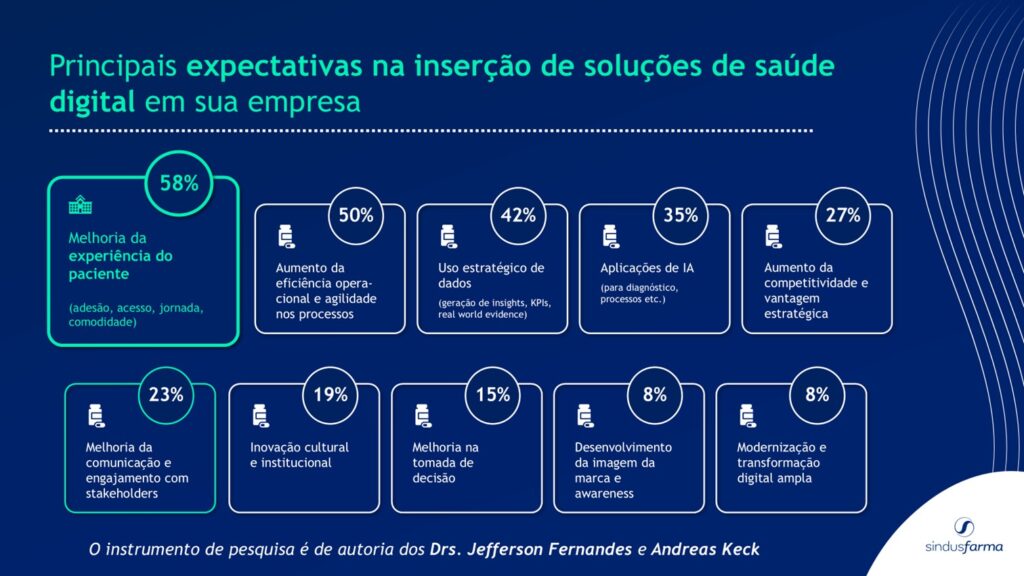
The main goals of current initiatives include improving patient experience (58%), increasing operational efficiency (50%), and using data strategically to generate insights and real-world evidence (42%). Artificial intelligence is also gaining traction, with 35% of companies highlighting AI for diagnostics and process automation (Figure 2).
Global Benchmarks Show What’s Possible
These trends reflect a partial alignment with the international industry, where the use of digital technologies is already more consolidated and structured. Major global pharmaceutical companies have been investing heavily in large-scale data platforms, AI-powered prediction models, remote patient monitoring, and integration with digital health ecosystems.
Globally, the impact of digital technologies in pharma is accelerating across the entire value chain. According to Mordor Research, 95% of pharmaceutical companies are already investing in AI, with investment expected to grow from USD 4 billion in 2025 to USD 25 billion by 2030. The field of AI-powered drug discovery is particularly dynamic: 8 of the 10 largest M&A deals have taken place since 2023.
The potential goes far beyond R&D. From early patient identification and personalized treatment pathways to intelligent monitoring and digital therapeutic support, new ways to improve outcomes and cost-effectiveness are rapidly emerging. All ten of the world’s top pharmaceutical companies have established strategic AI partnerships since 2023. AI-generated molecules can reach preclinical milestones up to 40% faster than traditional methods.
Generative AI is also gaining importance as a tool for internal productivity, particularly in medical content creation, commercial operations, and strategic data use. Companies that optimize their content for GenAI search tools are seeing significantly improved visibility in clinical and patient-facing queries. Traditional search engines are losing relevance as users increasingly rely on GenAI environments for medical information.
A study conducted by Deloitte (2022) shows that 77% of global pharmaceutical companies consider digital health an essential strategic pillar, with investments directed towards solutions such as decentralized clinical trials, wearables for continuous monitoring, and partnerships with health tech companies to accelerate patient-oriented innovation. McKinsey (2021) also reinforces that leading companies are moving away from isolated projects and adopting integrated digital transformation approaches across the entire value chain.
A Perspective for Pharmaceutical Companies in Brazil
In Brazil, barriers still persist – fragmented healthcare systems, limited interoperability, regulatory challenges in the use of sensitive data, especially for analytical and predictive purposes, and limitations in internal innovation structures.
However, the growing maturity of the healthcare startup ecosystem and regulatory advances by ANVISA and the Ministry of Health open up new perspectives for the development of this agenda.
Comparing the two contexts, it is clear that, while globally, digital health is seen as a lever for organizational transformation, in Brazil it is still strongly anchored in tactical objectives, such as efficiency gains or improved communication with stakeholders. To advance, local pharmaceutical companies will need to broaden their strategic vision and invest in building internal capacity, collaborative models with the public and private sectors, and robust impact assessment criteria.
The adoption of digital health in Brazil is underway—and, although the starting point is different from the international scenario, the potential for convergence is significant. The challenge now is to accelerate the transformation journey, fostering an environment that fosters innovation with a real impact on patients, physicians, and the industry itself.
From Global Strategy to Local Execution
International experience from Syte Institute’s and SPECIS in global and regional implementation projects shows that digital health and AI only become commercially relevant when strategic positioning, technical execution, and operational integration go hand in hand. The challenge lies in translating global benchmarks into locally executable models. While global headquarters often focus on data platforms and proprietary infrastructure, local organizations need fast, affordable, and high-impact solutions.
References
1. Deloitte. (2022). Digital transformation and innovation in the pharmaceutical industry. Deloitte Insights. Available at: https://www2.deloitte.com/
2. McKinsey & Company. (2021). Digital health: How pharma can win the transformation race. McKinsey & Company.
3. IQVIA Institute (2024), Digital Health Trends 2024, Dez/2024. Available at: iqvia.com+1Galen Growth+1
4. Straits Research (2024), Pharma 4.0 Market Size 2024. Available at: straitsresearch.com
5. Wifitalents (2025), Digital Transformation in Pharma 2025. Available at: WifiTalents
Saúde Digital no Setor Farmacêutico Brasileiro: Insights de um Mercado em Transição
Resumo Executivo
A transformação digital atingiu o setor farmacêutico brasileiro – embora em condições diferentes nas sedes globais e nas afiliadas locais. Enquanto os centros globais se concentram em estratégias de plataforma e infraestrutura de IA, as equipes locais buscam soluções rápidas, práticas e relevantes para a receita. É aqui que surgem necessidades claras de implementação: da identificação e engajamento do paciente à IA em ensaios clínicos, visibilidade da GenAI e desenvolvimento de capacidades.
O Setor Farmacêutico Brasileiro Está Pronto – O Que Falta é Execução Consistente
A transformação digital da saúde é uma realidade global, e a indústria farmacêutica desempenha um papel cada vez mais ativo nessa mudança. No Brasil, a adoção de tecnologias de saúde digital pela indústria farmacêutica ainda está em estágio inicial, embora já estejam surgindo sinais promissores de maturidade e impulso.
Uma pesquisa recente conduzida pelo Centro de Pesquisa do SINDUSFARMA, com curadoria do Dr. Jefferson Fernandes (SPECIS, Brasil) e do Dr. Andreas Keck (Instituto Syte, Alemanha), analisou o estado atual da adoção da saúde digital em 58 empresas farmacêuticas nacionais e internacionais que operam no Brasil*.
Entre outras descobertas, o estudo revelou que apenas 3% das empresas operam atualmente soluções de saúde digital totalmente integradas. Enquanto isso, 31% estão expandindo as iniciativas existentes, 29% estão explorando novas oportunidades, 21% estão em fase de planejamento e estratégia e 16% estão pilotando projetos de saúde digital. Esses números refletem um setor em transição – a maioria dos players ainda está nos estágios iniciais de execução (Figura 1).
Saúde Digital é uma Prioridade Estratégica – Mas as Alavancas Operacionais Frequentemente São Subutilizadas
Os principais objetivos das iniciativas atuais incluem melhorar a experiência do paciente (58%), aumentar a eficiência operacional (50%) e usar dados estrategicamente para gerar insights e evidências do mundo real (42%). A inteligência artificial também está ganhando força, com 35% das empresas destacando a IA para diagnóstico e automação de processos (Figura 2).
Benchmarks globais mostram o que é possível
Essas tendências refletem um alinhamento parcial com a indústria internacional, onde o uso de tecnologias digitais já está mais consolidado e estruturado. Grandes empresas farmacêuticas globais têm investido fortemente em plataformas de dados em larga escala, modelos de previsão baseados em IA, monitoramento remoto de pacientes e integração com ecossistemas de saúde digital.
Globalmente, o impacto das tecnologias digitais na indústria farmacêutica está se acelerando em toda a cadeia de valor. De acordo com a Mordor Research, 95% das empresas farmacêuticas já estão investindo em IA, com previsão de crescimento de US$ 4 bilhões em 2025 para US$ 25 bilhões até 2030. O campo da descoberta de medicamentos com tecnologia de IA é particularmente dinâmico: 8 das 10 maiores fusões e aquisições ocorreram desde 2023.
O potencial vai muito além de P&D. Da identificação precoce do paciente e caminhos de tratamento personalizados ao monitoramento inteligente e suporte terapêutico digital, novas maneiras de melhorar os resultados e a relação custo-efetividade estão surgindo rapidamente. Todas as dez maiores empresas farmacêuticas do mundo estabeleceram parcerias estratégicas de IA desde 2023. Moléculas geradas por IA podem atingir marcos pré-clínicos até 40% mais rápido do que os métodos tradicionais.
A IA generativa também está ganhando importância como ferramenta para produtividade interna, particularmente na criação de conteúdo médico, operações comerciais e uso estratégico de dados. Empresas que otimizam seu conteúdo para ferramentas de busca GenAI estão observando uma visibilidade significativamente melhorada em consultas clínicas e voltadas para pacientes. Os mecanismos de busca tradicionais estão perdendo relevância à medida que os usuários dependem cada vez mais de ambientes GenAI para obter informações médicas.
Um estudo conduzido pela Deloitte (2022) mostra que 77% das empresas farmacêuticas globais consideram a saúde digital um pilar estratégico essencial, com investimentos direcionados a soluções como ensaios clínicos descentralizados, wearables para monitoramento contínuo e parcerias com empresas de tecnologia em saúde para acelerar a inovação orientada ao paciente. A McKinsey (2021) também reforça que as empresas líderes estão se afastando de projetos isolados e adotando abordagens integradas de transformação digital em toda a cadeia de valor.
Uma Perspectiva para as Empresas Farmacêuticas no Brasil
No Brasil, barreiras ainda persistem: sistemas de saúde fragmentados, interoperabilidade limitada, desafios regulatórios no uso de dados sensíveis, especialmente para fins analíticos e preditivos, e limitações nas estruturas internas de inovação.
No entanto, a crescente maturidade do ecossistema de startups da área da saúde e os avanços regulatórios da ANVISA e do Ministério da Saúde abrem novas perspectivas para o desenvolvimento dessa agenda.
Comparando os dois contextos, fica claro que, enquanto globalmente a saúde digital é vista como uma alavanca para a transformação organizacional, no Brasil ela ainda está fortemente ancorada em objetivos táticos, como ganhos de eficiência ou melhoria da comunicação com stakeholders. Para avançar, as empresas farmacêuticas locais precisarão ampliar sua visão estratégica e investir na construção de capacidade interna, em modelos colaborativos com os setores público e privado e em critérios robustos de avaliação de impacto.
A adoção da saúde digital no Brasil está em andamento — e, embora o ponto de partida seja diferente do cenário internacional, o potencial de convergência é significativo. O desafio agora é acelerar a jornada de transformação, fomentando um ambiente que promova inovação com impacto real para pacientes, médicos e a própria indústria.
Da Estratégia Global à Execução Local
A experiência internacional do Syte Institute e da SPECIS em projetos de implementação globais e regionais mostra que a saúde digital e a IA só se tornam comercialmente relevantes quando posicionamento estratégico, execução técnica e integração operacional andam de mãos dadas. O desafio está em traduzir benchmarks globais em modelos executáveis localmente. Embora as sedes globais frequentemente se concentrem em plataformas de dados e infraestrutura proprietária, as organizações locais precisam de soluções rápidas, acessíveis e de alto impacto.
*Para saber mais sobre as oportunidades em Saúde Digital, visite https://specismed.com/; https://sytelatam.com; https://www.syte-institute.com/
References
1. Deloitte. (2022). Digital transformation and innovation in the pharmaceutical industry. Deloitte Insights. Disponível em: https://www2.deloitte.com/
2. McKinsey & Company. (2021). Digital health: How pharma can win the transformation race. McKinsey & Company.
3. IQVIA Institute (2024), Digital Health Trends 2024, Dez/2024. Disponível em: iqvia.com+1Galen Growth+1
4. Straits Research (2024), Pharma 4.0 Market Size 2024. Disponível em: straitsresearch.com
5. Wifitalents (2025), Digital Transformation in Pharma 2025. Disponível em: WifiTalents
Figura 1
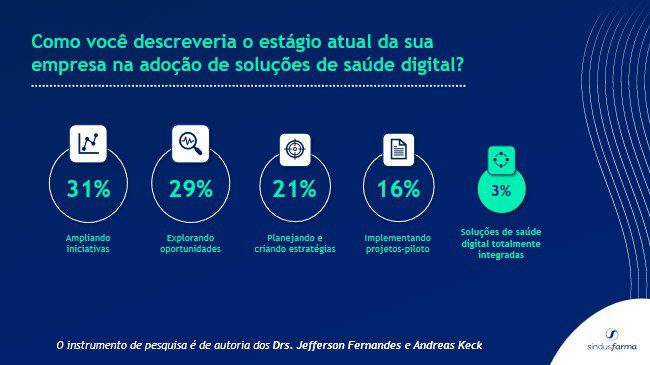
Figura 2